
3 Java Projects Every Beginner Build Before Applying for a Developer Job
Why Projects Matter Before Your First Job
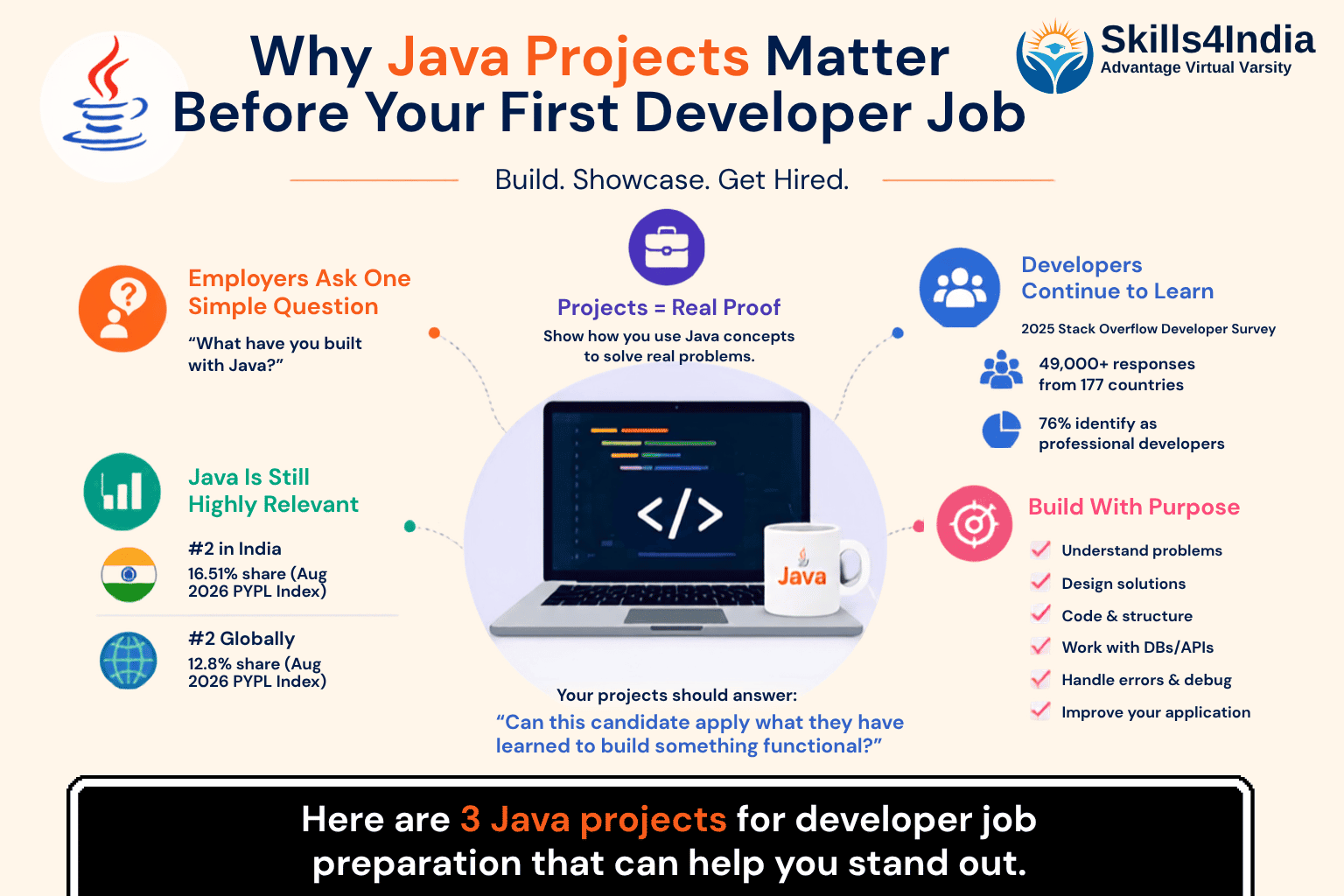
Knowing Java syntax is only the starting point. Employers also want to understand whether you can apply Java concepts to solve practical problems. A recruiter or technical interviewer may ask a simple
but important question: “What have you built with Java?”
Projects give you concrete evidence of your technical skills. Instead of only claiming that you know:
1. Classes and objects
2. Inheritance and interfaces
3. Exception handling
4. Collections
5. SQL and databases
you can demonstrate where and why you used these concepts.
Java remains a relevant technology for building a developer portfolio. According to the August 2026 PYPL index, Java ranks second in India with a 16.51% share of programming-language tutorial searches and ranks second globally with a 12.8% share.
The 2025 Stack Overflow Developer Survey, based on more than 49,000 responses from 177 countries, shows that 76% of respondents identify as professional developers, highlighting the continued importance of practical development skills and ongoing technical learning.
For beginners, the key takeaway is:
do not build projects simply to increase the number of GitHub repositories. Build projects that demonstrate how you:
1. Understand a problem
2. Design a solution
3. Write and structure code
4. Work with databases or APIs
5. Handle errors and edge cases
6. Debug problems
7. Improve your application
Your projects should ultimately answer one important question for a potential employer: “Can this candidate apply what they have learned to build something functional?”
With that goal in mind, here are three Java projects for developer job preparation that can help beginners demonstrate progressively stronger development skills.
Student Management System Using Java and MySQL
A Student Management System is one of the most useful Beginner Java projects because it can start simple and gradually become a realistic CRUD application.Instead of creating a basic console program that only stores names and marks, build a system where an administrator can:
1. Add, update, search, and delete student records
2. Store student information in MySQL
3. Validate user input
4. Search students by ID, department, or name
5. Calculate and display academic performance
6. Handle invalid inputs and database errors
7. Separate application logic from database operations
What does this project prove? It demonstrates that you understand more than Java syntax.
You can showcase:
Java: classes, objects, inheritance, interfaces, collections and exception handling
Database: SQL, tables, relationships, INSERT, UPDATE, DELETE and SELECT queries
Programming practice: validation, modular code and error handling For your GitHub repository, include a README explaining the problem, features, technology stack, database structure, screenshots and instructions for running the application.
This makes the project much more useful as one of your Java developer portfolio projects because an interviewer can actually ask you about design decisions.
Employee Management and Payroll System
The second project should introduce more business logic.
An Employee Management and Payroll System is among the strongest Java projects before job application because it allows beginners to demonstrate how software can represent a real organizational process.
Your application could allow HR or an administrator to:
Add and manage employee records
Assign departments and job roles
Track attendance
Calculate salary
Apply allowances and deductions
Generate monthly salary information
Search employees
Export or display payroll reports
The important part is not simply creating the interface.
Think about the logic.
For example:
Net Salary = Basic Salary + Allowances − Deductions
You can then create Java classes such as Employee, Department, Attendance, Payroll and SalaryCalculator.
This gives you an opportunity to explain object-oriented programming in an interview using your own project rather than a textbook example.
Why is this better than another basic Java project?
Because it forces you to answer questions that resemble real software development:
What happens when an employee does not exist?
How should invalid salary data be handled?
How will employee records be searched?
How should database errors be managed?
How will different employee types be represented?
E-Commerce or Inventory REST API Using Java
If the first two projects demonstrate Java fundamentals and database skills, the third should show that you understand how modern applications communicate.
Build a small E-Commerce or Inventory REST API using Java and a framework such as Spring Boot.
Your API could support:
Product creation
Product updates
Product deletion
Product search
Category filtering
Stock management
Customer records
Order creation
Basic authentication
HTTP status codes
JSON request and response handling
This is where your portfolio starts moving from “student project” toward “developer project.”
The 2025 Stack Overflow survey shows that developers continue to work across databases, cloud technologies, web frameworks and development tools rather than relying on a single programming language alone.
That makes a project combiningJava + Spring Boot + REST API + SQL + Gitmuch more valuable than a collection of isolated Java syntax exercises.
For your Java developer portfolio projects, document the API endpoints and provide sample requests and responses.
For example:
GET /products
POST /products
PUT /products/{id}
DELETE /products/{id}
What Should a Beginner Put in a Java Portfolio?
Three projects are enough if each one demonstrates a different level of ability.
Project | Main Skills Demonstrated |
Student Management System | Core Java + OOP + SQL + CRUD |
Employee Payroll System | OOP + Business Logic + JDBC/MySQL |
E-Commerce REST API | Java + Spring Boot + REST + Database |
The goal is not to have 15 unfinished repositories.
A stronger approach is to have three complete projects that you can explain from beginning to end.
Every project should ideally contain:
A clear README
Source code
Database/schema information
Screenshots or demo
Setup instructions
Technologies used
Key features
Challenges and solutions
Git commit history
Testing information
Why Java Internship With Skills4India is Best
Building projects independently is valuable, but beginners often face two challenges: what to build and how to approach projects like real internship assignments.
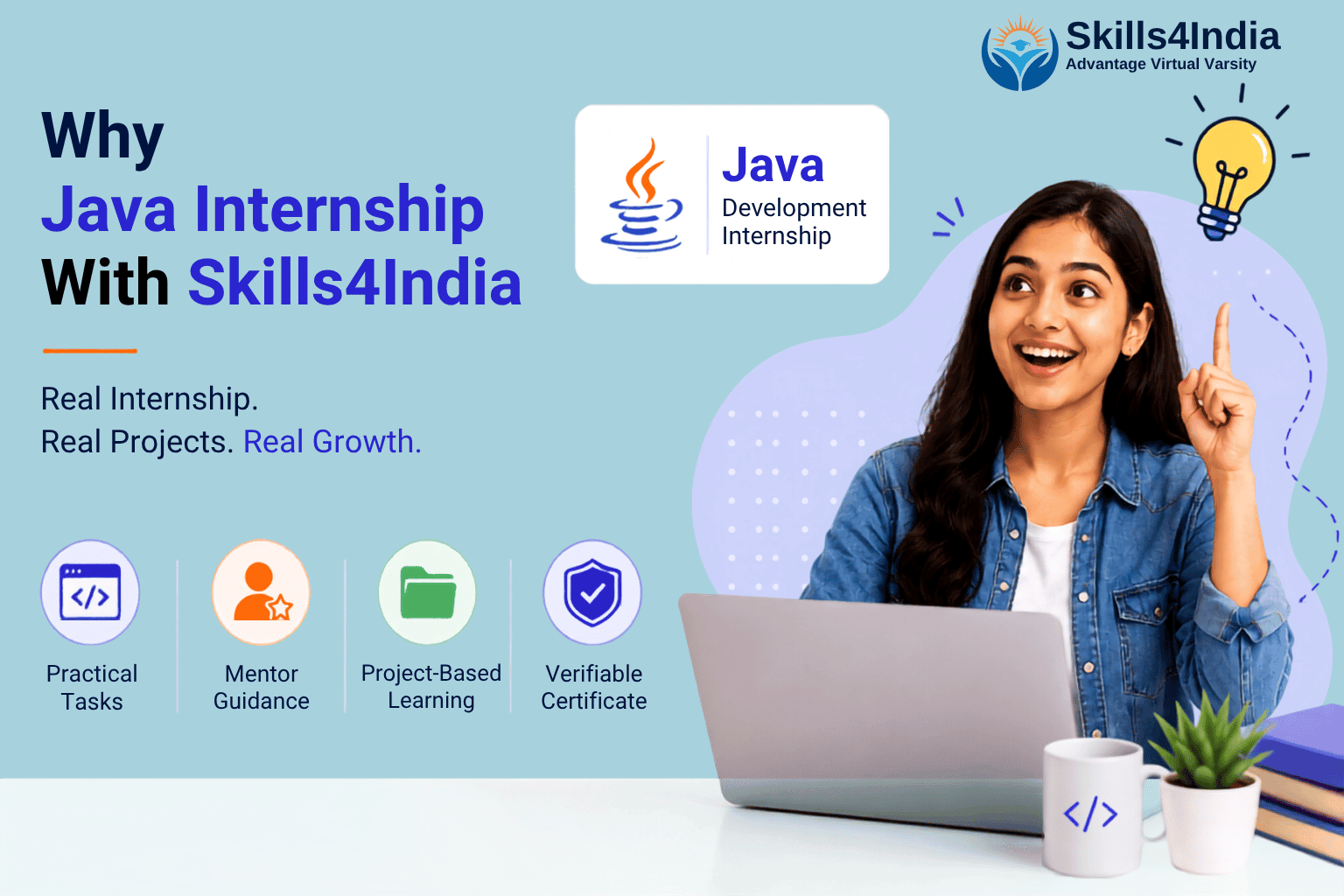
A practical internship can help bridge that gap. With the Skills4India Java Development Internship, students can get:
- Practical Java development tasks instead of only watching tutorials or studying theory.
- Internship-style project experience that helps beginners understand how development work is structured.
- Mentor guidance to support the learning and project-building process.
- Project-based assignments that allow students to apply Java concepts in practical scenarios.
- Solution files that can help learners understand the expected approach after completing tasks.
- Project experience through applications such as a Student Management App and Employee Records App.
- Project evaluation to give students feedback on their submitted work.
- A digitally verifiable completion certificate after successfully completing the internship.
Final Words
If your goal is to become a Java developer, don't stop at tutorials and basic coding exercises. Start your Java Development Internship with Skills4India and take the next step toward building practical, job-oriented development experience.
👉 Ready to start building? Explore the Skills4India Java Development Internship and begin your project-based learning journey.