CONTENT
5 Skills You Need to Become a Job-Ready Java Developer
What Does "Job-Ready" Mean for a Java Developer?
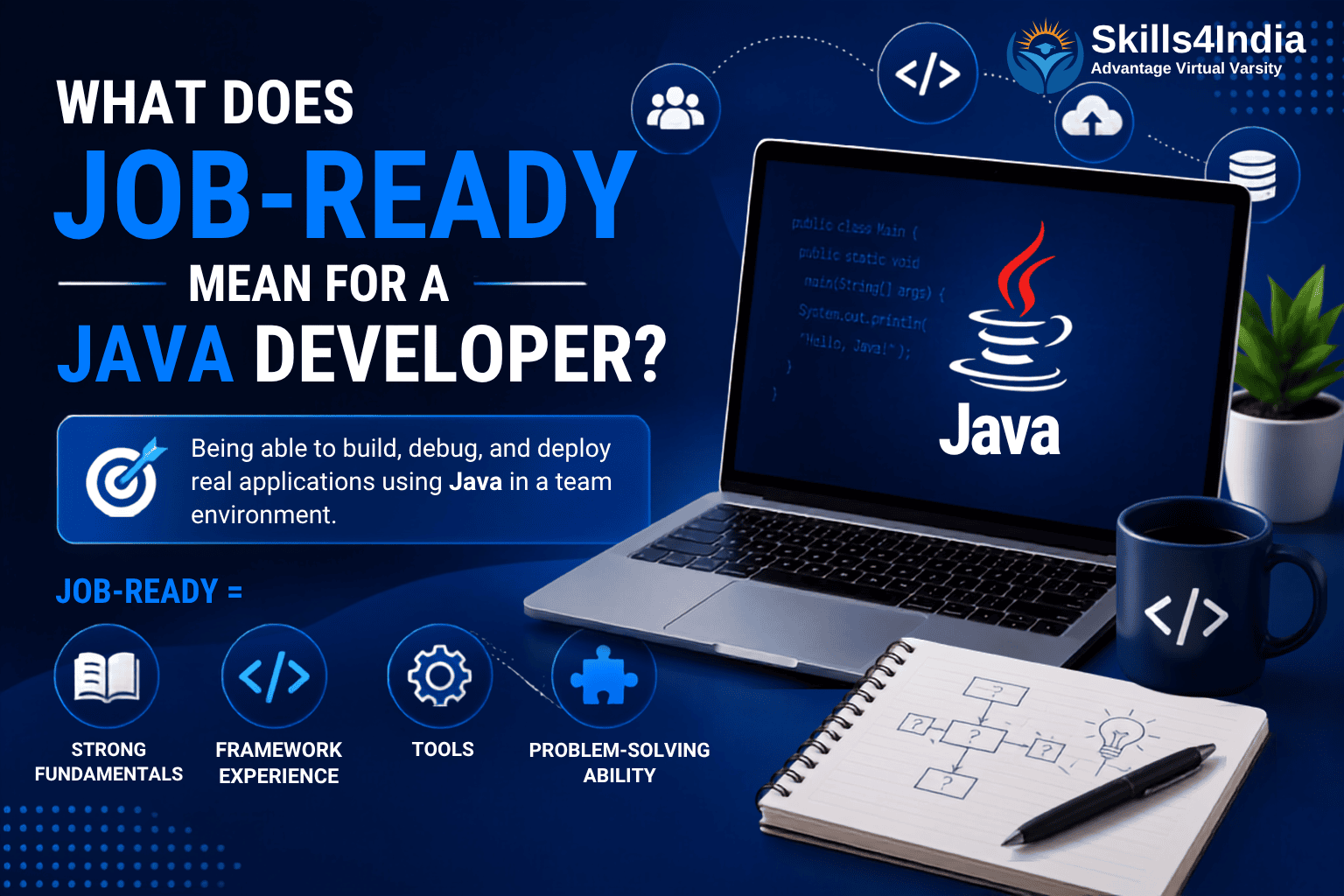
Being job-ready doesn't mean knowing Java syntax. It means being able to build, debug, and deploy real applications using Java in a team environment. Recruiters look for candidates who combine technical depth with practical, production-level experience this combination is what defines true job-ready Java developer skills.
In short: job-ready = strong fundamentals + framework experience + tools + problem-solving ability.
Here are the five skills that make up that combination.
1. Strong Core Java and OOP Fundamentals
Every job-ready Java developer skill set starts with the basics done right. Employers test candidates on:
1. Object-Oriented Programming (OOP) inheritance, polymorphism, encapsulation, abstraction
2. Exception handling and multithreading
3. Collections framework (ArrayList, HashMap, LinkedList)
4. Java 8+ features like Streams and Lambda expressions
These core Java skills for beginners are non-negotiable. Most technical interviews start here, and weak fundamentals are the fastest way to get filtered out regardless of how many frameworks you claim to know.
2. Hands-On Experience with Java Frameworks (Spring & Spring Boot)
Knowing Java alone isn't enough anymore. Almost every enterprise-level Java job today requires framework experience, especially:
Spring and Spring Boot-for building REST APIs and microservices
Hibernate/JPA-for database interaction without writing raw SQL every time
Dependency Injection and MVC architecture concepts
3. Database Management and SQL Skills
A Java developer who can't work with databases is only half job-ready. You need to be comfortable with:
1. Writing SQL queries (SELECT, JOIN, GROUP BY, subqueries)
2. Understanding relational database design (MySQL, PostgreSQL)
3. Basic exposure to NoSQL databases like MongoDB
Since most real-world applications store and retrieve data constantly, database fluency is one of the most tested job-ready Java developer skills in interviews often through live coding or take-home assignments.
4. Version Control and Collaborative Development (Git)
No company works without version control, so Git isn't optional. Employers expect you to know:
Git basics commit, push, pull, branch, merge
Resolving merge conflicts
Using platforms like GitHub or GitLab for collaboration
Working with pull requests in a team workflow
5. Problem-Solving and Data Structures & Algorithms (DSA)
Almost every Java developer role from startups to product-based giants tests DSA in interviews. Focus on:
Arrays, strings, linked lists, stacks, and queues
Sorting and searching algorithms
Time and space complexity (Big-O notation)
Practicing on platforms like LeetCode or HackerRank
How to Build These Job-Ready Java Developer Skills (Step-by-Step Roadmap)
If you're mapping out a Java developer roadmap, follow this order:
Master core Java and OOP concepts (4–6 weeks)
Learn SQL and database design (2–3 weeks)
Build 2–3 projects using Spring Boot (4–6 weeks)
Practice Git and deploy projects on GitHub
Solve DSA problems daily and take mock interviews
FAQ'S
Q1: What are the most important job-ready Java developer skills for freshers?
Ans- Core Java, OOP concepts, SQL, Git, and at least one framework like Spring Boot are the most important Java developer skills for freshers to focus on before applying for jobs.
Q2. How long does it take to become a job-ready Java developer?
Ans- With consistent effort, most learners can build solid job-ready Java developer skills in 4 to 6 months, especially when following a structured Java certification course.
Q3. Do I need Spring Boot to get a Java developer job?
Ans- While not always mandatory for entry-level roles, Spring Boot experience is expected for most product-based and enterprise Java positions today.
Q4. Is DSA really necessary for Java developer interviews?
Ans- Yes. Most technical interviews, especially at mid-to-large companies, include DSA rounds to evaluate problem-solving ability alongside Java knowledge.
Why Skill4India Is the Best Place to Pursue Your Java Development Internship