
Java Developer Roadmap for Beginners

  CONTENT

​​Java Developer Roadmap Beginner to Job-Ready Guide    
Wondering how to become a Java developer without drowning in scattered tutorials and half-finished courses? This Java developer roadmap breaks the entire journey into 8 clear stages from your first line of code to your first interview. Built on real 2026 hiring data and hands-on practice through Skills4India project-based internships, it's the most practical Java learning path for beginners you'll find. Follow it in order, and beginner to job-ready Java stops being a vague goal and becomes a plan you can actually execute.

Smiling young woman pointing down toward a “The Golden Roadmap to Become a Job-Ready Java Developer” banner with a “Scroll Down” call-to-action

​​Java Fundamentals: The Starting Point of Every Java Developer Roadmap       

Every solid Java roadmap for beginners starts here: programming basics, Java syntax, variables and data types, operators and control flow, methods, arrays and strings, and input/output. This stage isn't about memorizing syntax it's about training your brain to think in logic. Skip it, and every later stage (OOP, frameworks, Spring Boot) gets harder than it needs to be. Spend 3–4 weeks here before moving on.

​​Core Java & OOP: Where the Java Learning Path Gets Real   

This is the heart of any Java learning path for beginners. Classes, objects, constructors, encapsulation, inheritance, polymorphism, abstraction, interfaces, and exception handling these concepts define how Java applications are actually structured. Most technical interview questions for entry-level roles come straight from this stage, so don't rush it. If you're still asking how to become a Java developer at a professional level, this is the point where "knowing Java" turns into "thinking like a Java developer."

​​Collections & Modern Java: Writing Production-Ready Code  

Once OOP clicks, this Java developer roadmap moves to what separates hobbyists from hireable developers: List, Set, Map, ArrayList, HashMap, Generics, Lambda Expressions, the Stream API, Optional, and multithreading basics. Recruiters specifically look for comfort with Streams and Lambdas they're everywhere in modern Java codebases. This is also where a generic Java learning path for beginners usually ends, and where a genuinely job-focused one keeps going.

​​Database & SQL: Data Skills Every Job-Ready Java Developer Needs    


​No Java application survives without data. This stage covers SQL fundamentals, CRUD operations, joins, keys and relationships, transactions, MySQL or PostgreSQL, and JDBC. If you're serious about how to become a Java developer, treat SQL as equally important as Java itself almost every backend role tests it.

​​Developer Tools: The Professional Toolkit      


Git and GitHub, Maven, IDE debugging, and dependency management round out this stage of the Java developer roadmap. These aren't "extras" they're what separates someone who writes code from someone who ships code on a real team. Most Java roadmap for beginners guides skip this stage entirely, which is exactly why so many self-taught learners struggle in their first job.


​​Web & Backend Development: Building Real Applications  

Here the roadmap gets exciting: HTTP and JSON, REST APIs, the Spring Framework, Spring Boot, dependency injection, controllers and services, and API validation and error handling. This is where you start building applications that look and behave like production software a major milestone in any Java roadmap for beginners, and the point where most job descriptions for "Java Developer" actually start matching your skill set.


​​Database Integration & Security: Making It Job-Ready     

JPA and Hibernate, entities and relationships, Spring Data JPA, authentication, authorization, Spring Security, and JWT basics complete the technical skill set. Combined with stage 6, this is what makes beginner to job-ready Java a reality rather than a slogan you're now building secure, database-driven backend systems, exactly what companies hire for.

​​Projects & Job Preparation: Turning Skills Into Offers         

The final stage of this Java developer roadmap is proof of work: beginner-to-advanced projects, a GitHub portfolio, DSA fundamentals, Java and SQL interview prep, Spring Boot interview questions, project-based interview practice, and a resume built around what you've actually shipped. This is the step most self-taught learners skip and it's the one that actually completes the shift from beginner to job-ready Java developer.

​​Why Java  Development Is Still Worth It in 2026         
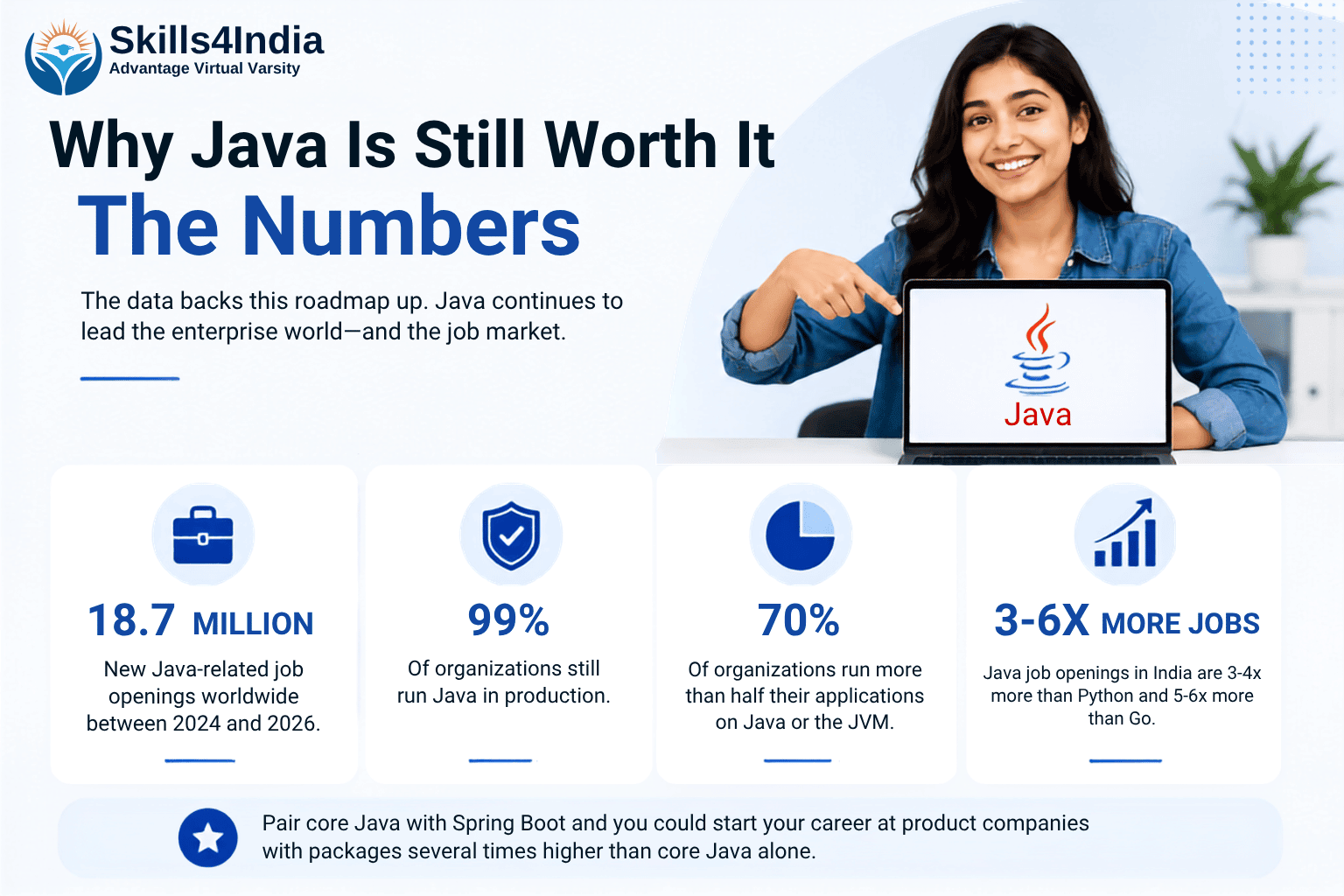
Infographic titled “Why Java Is Still Worth It in 2026: The Numbers,” featuring a smiling woman with a laptop and four key statistics about Java jobs, production use, JVM adoption, and job demand in India
The data backs this roadmap up. Industry projections point to roughly 18.7 million new Java-related job openings worldwide between 2024 and 2026, and Java remains one of the most sought-after skills in Indian tech recruitment. Azul's 2026 State of Java survey found that 99% of organizations still run Java in production, with about 70% powering more than half their applications on Java or the JVM concentrated heavily in banking, insurance, and telecom, sectors that dominate Indian IT hiring. 
​
​On sheer job volume, Java also leads India's backend market: openings for Java roles run an estimated 3-4 times those for Python and 5-6 times those for Go. Freshers who pair core Java with Spring Boot and land roles at product companies can see starting packages several times higher than those who stop at core Java alone. In short: if you're figuring out how to become a Java developer, the market still says yes.

​​Why Skills4India Is the Smartest Way to Follow This Roadmap           

1. Project-Based Learning: Build real applications such as a Student Management App and Employee Records App instead of only watching tutorials.
2. Step-by-Step Structure: Follow a beginner-to-job-ready learning path with projects introduced week by week.
3. 1:1 Mentor Guidance: Get support from industry experts whenever you get stuck or need help understanding a concept.
4. Solution Code Files: Compare your implementation with solution files to identify mistakes and improve your coding approach.
5. Internship Certificate: Receive a digitally verified, LinkedIn-shareable Internship Certificate upon completion.
6. Flexible & Remote: Complete the internship remotely and manage your learning alongside college.
7. Career-Focused Learning: Turn your Java knowledge into practical projects and a stronger portfolio.
8. Industry-Relevant Exposure: Gain practical experience designed to help bridge the gap between learning Java and becoming job-ready.


Ready to turn your Java roadmap into real projects? Start your Skills4India Java Development Internship and take the next step toward becoming job-ready.